Chromosome-Level Genome Assembly of White-Spotted Bamboo Shark: Insights into Evolution and Immunity
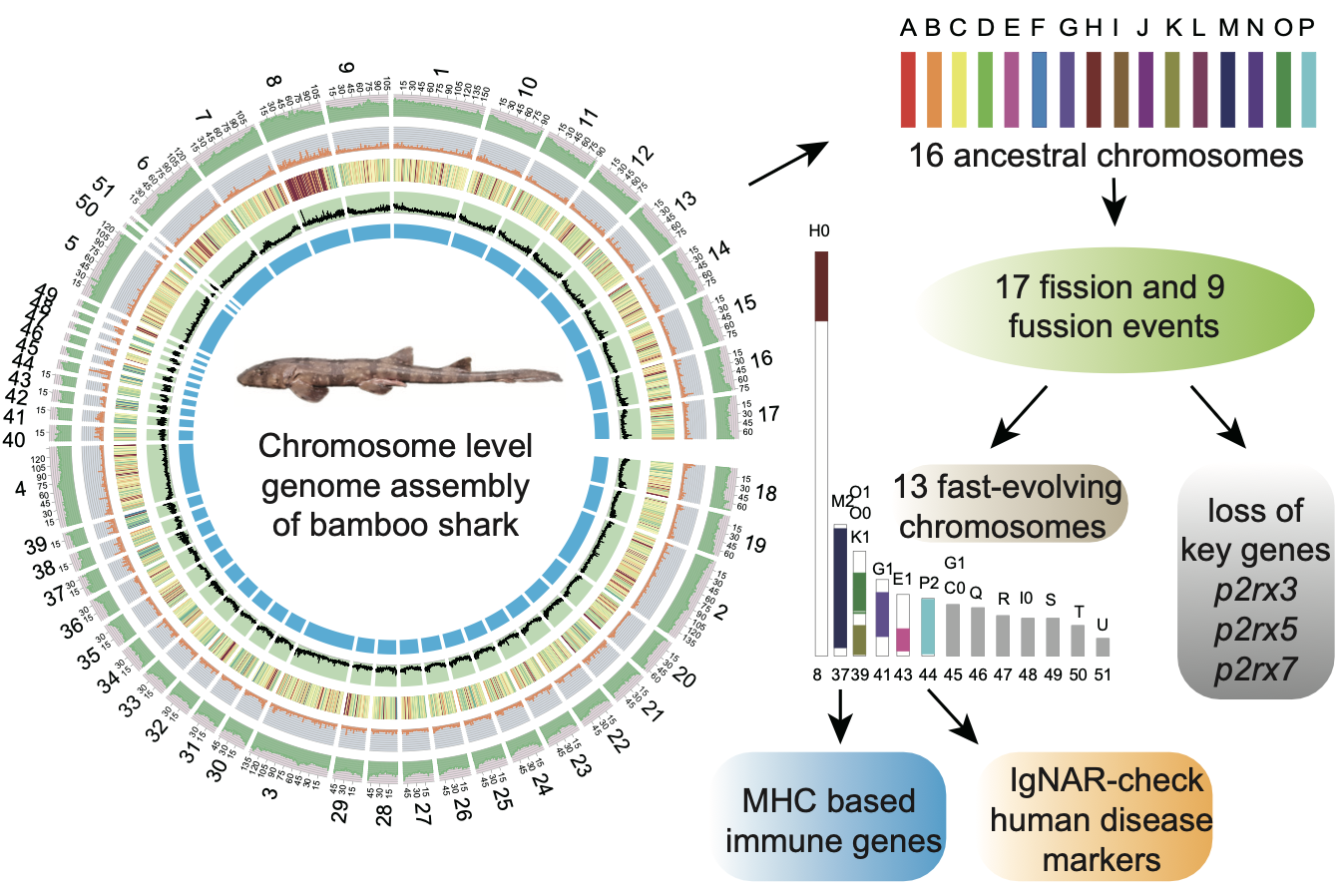
Cartilaginous fish, such as sharks, represent an early branch in vertebrate evolution, offering valuable insights into chromosome evolution, immunity, and skeletal development. In our recent study published in iScience, we present a chromosome-level genome assembly of the white-spotted bamboo shark (Chiloscyllium plagiosum), providing new resources for understanding the genomic dynamics of cartilaginous fish.
Key Findings
-
High-Quality Genome Assembly:
Using Hi-C chromatin interaction data, we successfully assembled a 3.85 Gb genome with 51 chromosomes, offering one of the most complete genomic references for cartilaginous fish. -
Reconstruction of Ancestral Shark Chromosomes:
By comparing bamboo shark genome data with that of other cartilaginous fish, we reconstructed 16 ancestral chromosomes and mapped their evolutionary trajectories. Our analysis revealed a dynamic chromosome rearrangement process, with 17 fission and 9 fusion events shaping the bamboo shark genome. -
Rapidly Evolving Chromosomes and Immune Genes:
Our study identified 13 fast-evolving chromosomes, enriched in immune-related genes, including major histocompatibility complex (MHC) genes and expanded TRIM gene families, which are associated with antiviral defense mechanisms. -
Loss of Bone Formation-Related Genes:
Chromosome rearrangements led to the loss of three key genes involved in bone formation (p2rx3, p2rx5, and p2rx7), reinforcing the chondrification of the cartilaginous fish skeleton, a distinctive trait in sharks. -
Potential Biotechnological Applications of Shark Antibodies:
Bamboo sharks possess single-domain antibodies (IgNAR), which we successfully expressed in a phage display system. These antibodies showed high affinity for human disease markers, highlighting their potential use in biomedical applications.
Reflections
Since establishing our Qingdao branch, marine genomics has become a key research focus for XinLab. Leveraging our sequencing technologies, we have conducted genomic sequencing across various marine species, and the bamboo shark genome project represents one of our most successful initiatives in this field. Unlike some other shark species with highly complex genomes, bamboo shark genomes are comparatively less difficult to assemble, allowing us to obtain high-quality genomic sequences for evolutionary and functional studies.
Our analyses not only contributed to understanding chromosome evolution and immune gene expansion in cartilaginous fish but also provided insights into their skeletal adaptations. The identification of shark-derived single-domain antibodies presents exciting possibilities for biotechnological and pharmaceutical applications, further bridging evolutionary genomics with biomedical research. Moving forward, our team is expanding marine genomics projects, continuing to explore the genomes of additional cartilaginous species.
The full text of this study can be accessed online at iScience.