Chromosome-Scale Genome of Chitala ornata Illuminates Early Teleost Evolution
Chromosome-Scale Genome of Chitala ornata Illuminates Early Teleost Evolution
Our recent publication — a chromosome-scale genome assembly of Chitala ornata, the Clown featherback, a pivotal species within the early teleosts. This state-of-the-art genomic resource not only sets a new standard for the Osteoglossiformes but also sheds light on the evolutionary history of early teleost fishes, a group that comprises the most diverse vertebrates on the planet.
Key Findings
-
High-Quality Genome Assembly:
We assembled an 837-megabase genome with an impressive contig N50 of 32.78 Mb and scaffold N50 of 40.73 Mb. By anchoring 94.78% of the assembly onto 21 chromosomes, our work represents the highest quality genome available for this group so far. -
Evolutionary Insights:
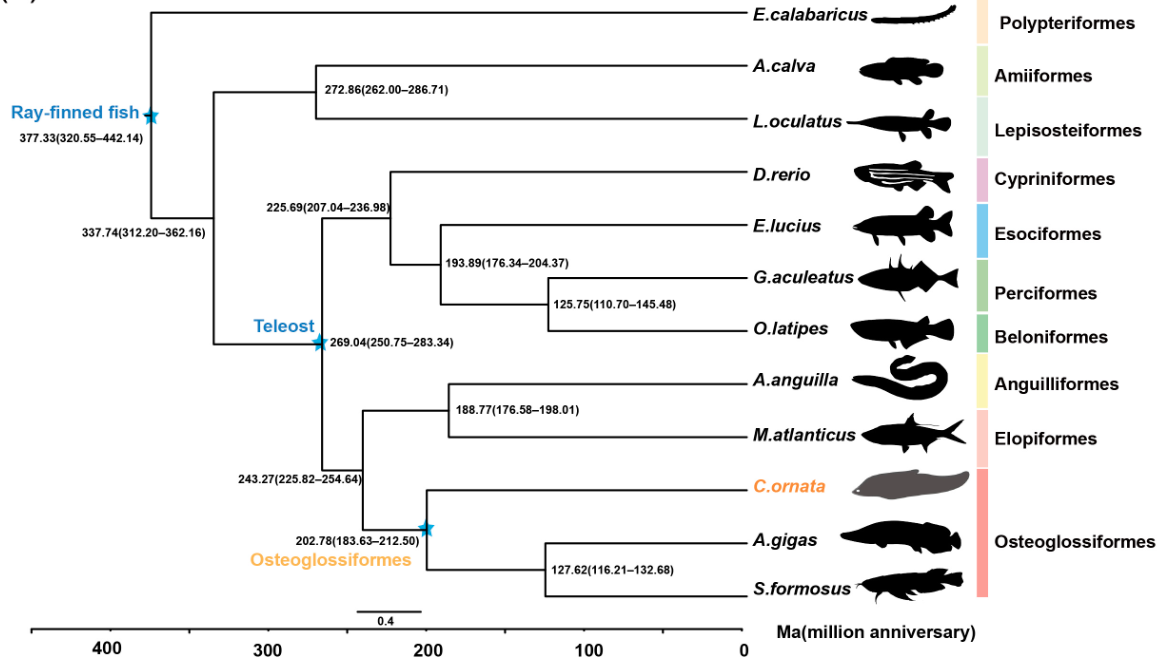
Our phylogenetic analysis indicates that Chitala ornata diverged around 203 million years ago, a period that correlates intriguingly with continental separation events. This timing provides important context for the macroevolutionary patterns seen in early teleost fishes. -
Decoding Pectoral Fin Evolution:
One of the most fascinating discoveries was a unique deletion of regulatory elements adjacent to the Gli3 gene—an observation that might underlie the specialized adaptation of pectoral fins in teleosts. In addition, we uncovered specific patterns of transposable element (TE) expansions and contractions that likely contributed to the unique compactness of the teleost genome.
Reflections on the Journey
This work is majorly finished by one of Xin’s Ph.D. student, Zengbao Yuan, and the team at BGI Research Qingdao dedicated to marine genomics. It reaffirms our commitment to decoding the mysteries of evolution and applying these insights to a broader understanding of vertebrate biology.
Looking Ahead
Our comprehensive genomic data provides an invaluable resource for further studies on early teleost evolution. We are eager to explore the functional implications of the regulatory changes we’ve observed, especially concerning the evolution of pectoral fins, and to extend these insights to other pivotal traits across vertebrates.
I look forward to sharing more of our discoveries and the challenges we overcome along the way. Every project like this reaffirms my belief in the endless wonder of evolution—and in the vital role that genomics plays in unraveling its secrets.