Cell Article: Genomic Insights into the Population Dynamics and Adaptation of Hadal Amphipods
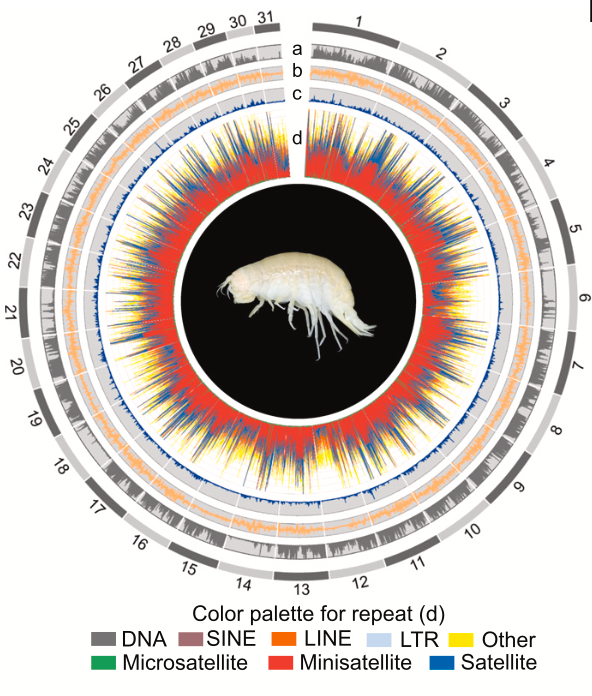
Our recent study in Cell, based on the genomes of over 600 deep-sea amphipods, reveals how host-symbiont interactions drive adaptation to the extreme pressure of the Mariana Trench.
We are proud to announce the publication of “The amphipod genome reveals population dynamics and adaptations to hadal environment” in Cell. This collaborative study between XinLab, IDSSE (CAS), and BGI Research provides a comprehensive genomic roadmap of the hadal amphipod Hirondellea gigas.
Background
The hadal zone (6,000–11,000 meters deep) presents some of the harshest conditions on Earth, including crushing hydrostatic pressure and extreme food scarcity. H. gigas is a dominant scavenger in these depths, yet how it maintains population connectivity and survives such pressure remained poorly understood due to the challenges of deep-sea sampling.
Key Breakthroughs
- Genetic Homogeneity at 10,000m: By sequencing over 600 individuals from the Mariana Trench (MT), Yap Trench (YT), and the Central Basin Spreading Center (CBSC), we discovered high genetic connectivity within the MT. This suggests that the hadal environment is not a barrier to dispersal within a single trench. However, significant differentiation exists between trenches, following an isolation-by-distance pattern.
-
Symbiotic Survival Strategies:
Our multi-omics analysis unveiled a sophisticated metabolic complementarity between the amphipod host and its Psychromonas symbionts:
- High-Pressure Adaptation: Symbionts convert choline into trimethylamine (TMA), which the host then oxidizes into trimethylamine N-oxide (TMAO) via expanded fmo3 genes. TMAO acts as a “piezolyte,” stabilizing proteins against high-pressure deformation.
- Nutrient Scavenging: Symbionts assist the host in degrading cellulose and other refractory organic matter, providing essential energy in the food-limited hadal zone.
- Evolutionary Signatures: Genomic analysis identified expansion and positive selection in gene families related to hydrostatic pressure sensing, circadian rhythm loss, and specialized energy metabolism.
Significance
This work represents the largest hadal population genomics study to date. It highlights that the “holobiont”—the integrated unit of host and microbe—is the secret to colonizing the deepest parts of the ocean. These findings offer profound insights into marine biodiversity and the evolutionary limits of life on Earth.
Team & Collaboration
This study was led by researchers from IDSSE (CAS) and BGI Research. Guangyi Fan et al. from BGI contributed significantly to the large-scale population genetic analysis and the integration of multi-omic datasets. Xin Liu has been contributing a lot for rebuttal and revision processes of the manuscript.
Read the full article here: https://doi.org/10.1016/j.cell.2024.11.033