Nature Biotechnology: Decoding the Upland Cotton Genome and Its Polyploid Evolution
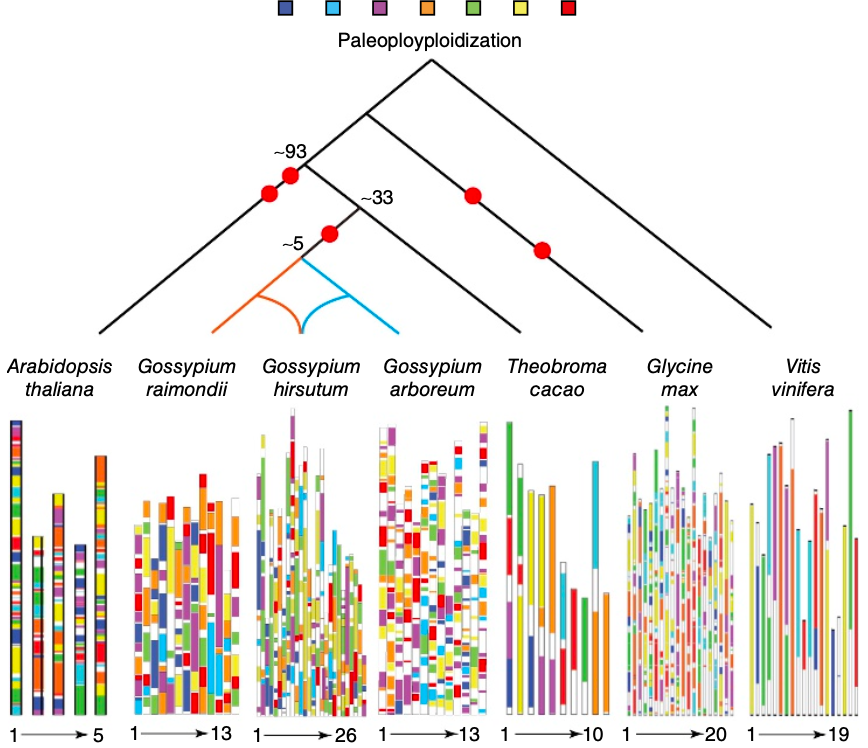
Our 2015 study in Nature Biotechnology presents the first high-quality assembly of the cultivated Upland cotton (TM-1) genome, uncovering how subgenome interactions drive fiber development.
The study “Genome sequence of cultivated Upland cotton (Gossypium hirsutum TM-1) provides insights into genome evolution,” co-authored by researchers including Xin Liu, was published in Nature Biotechnology.
Background
Upland cotton is the world’s most important natural fiber crop. However, its complex allotetraploid ($A_tD_t$) nature—resulting from the fusion of two distinct ancestral genomes—and high repetitive content made it one of the most challenging genomes to sequence and assemble.
Key Breakthroughs
- Solving the Tetraploid Puzzle: By integrating 181-fold paired-end sequences with BAC-to-BAC sequencing and a high-resolution genetic map, we produced a 2.17 Gb assembly for G. hirsutum TM-1, identifying 70,478 genes. At the time, this represented the most comprehensive genomic resource for cotton.
- Subgenome Synergies: The study revealed that the two subgenomes ($A_t$ and $D_t$) have undergone significant functional divergence since their polyploidization ~1–2 million years ago. Intriguingly, while the D-genome donor does not produce spinnable fibers, $D_t$ subgenome genes in Upland cotton play a vital role in fiber elongation.
- Molecular Drivers of Fiber Growth: We identified key genes involved in ethylene homeostasis and cell wall biosynthesis that are essential for the superior fiber length of Upland cotton compared to its diploid relatives.
- Transposable Elements (TEs): The analysis showed that the expansion of the cotton genome was largely driven by TE bursts, which in turn helped reshape the regulatory landscape of the species.
Significance
The Upland cotton genome sequence provides an invaluable “instruction manual” for cotton breeders. It has drastically accelerated the identification of quantitative trait loci (QTLs) for fiber quality and stress tolerance, paving the way for the development of “super cotton” varieties through genomic-assisted breeding.
Collaborative Effort
This milestone was the result of a massive collaboration involving the Cotton Research Institute of CAAS, BGI, Peking University, and several other leading institutions.
Read the full article here: https://doi.org/10.1038/nbt.3208