Conserved Chloroplast Genomes of Heliconia Revealed
We’re excited to share that XinLab has published a new study in Frontiers in Plant Science (2025, Vol. 15) titled “Unveiling the Conserved Nature of Heliconia Chloroplast Genomes: Insights from the University and the University of California, and the Complete Chloroplast Genomes.” Spearheaded by Xin Liu and Xin Cheng, with contributions from lab members and collaborators like John W. Kress (Smithsonian Institution), this work dives into the genomic underpinnings of Heliconia, the vibrant tropical plants known for their stunning bracts.
Why It Matters
Heliconia species, with their dazzling inflorescences, are ecological and horticultural stars of tropical regions. But what drives their diversity? Our study explores their chloroplast genomes—maternally inherited DNA that powers photosynthesis—to reveal evolutionary clues. By sequencing and comparing four Heliconia species, we’ve built a foundation for understanding their genetic stability and potential adaptations, offering resources for future plant science breakthroughs.
Key Findings
We assembled complete chloroplast genomes for Heliconia bihai, H. caribaea, H. orthotricha, and H. tortuosa, uncovering a striking level of conservation:
- Genome Structure: All four genomes are ~161,700 bp, with a quadripartite layout (LSC, SSC, two IR regions) typical of angiosperms, featuring 132 genes (86 coding, 8 rRNAs, 38 tRNAs).
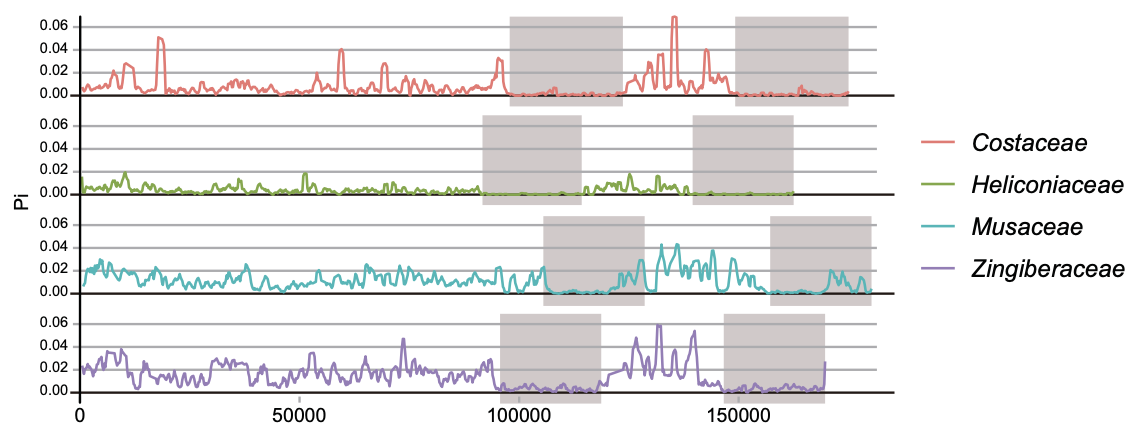
- Low Diversity: Nucleotide diversity (π) is lower in Heliconia than other Zingiberales families, suggesting their visual diversity isn’t tied to chloroplast variation.
- Repeat Sequences: Simple sequence repeats (SSRs) vary by species—e.g., H. tortuosa and H. orthotricha include hexanucleotide SSRs—offering potential genetic markers.
- Selection Signals: Genes like ndhD, rpl2, and ycf2 show signs of positive selection, hinting at roles in photosynthesis and protein import.
- Phylogenetic Insights: Heliconia forms a distinct clade in Zingiberales, closely related to Musaceae and Strelitziaceae, based on maximum likelihood analysis.
XinLab’s Role
This study showcases XinLab’s expertise in genomics and evolutionary biology. Xin Liu, the senior author, oversaw the project, while Xin Cheng led data curation and analysis. Lab members contributed to methodology and writing, collaborating with John W. Kress, a Heliconia expert from the Smithsonian. Meet the full team on our People page!
Explore the Work
- Read the Paper: Available open-access in Frontiers in Plant Science here.
- Access the Data: Chloroplast genomes are deposited in NCBI (PP093761, PP093760, PP093759, PP093762) and CNGBdb (CNP0005095). See supplementary data in the paper’s Table S1b.
Looking Ahead
Cheng Xin is a doctoral student of Xin Liu whose primary research focus is the Heliconia genome. In collaboration with our partners, we have collected several Heliconia species and conducted genome sequencing, with Cheng Xin mainly performing the genomic data analysis. In addition to the chloroplast genome, comparative analyses of the nuclear genomes of several species are underway and we hope to publish these results soon.
Moreover, because the Heliconia family includes many ornamental plants with uniquely distinctive flower morphologies and designs, and given the fascinating coevolution phenomena observed with hummingbirds, Cheng Xin recently traveled to Thailand to work with our partner at Nong Nooch Tropical Botanical Garden. There, we completed additional sampling of more species and various flower-related tissues. We will continue to advance research on the Heliconia genome and promote further studies on the evolution of Heliconia flower morphology.
Published on April 11, 2025, by XinLab